
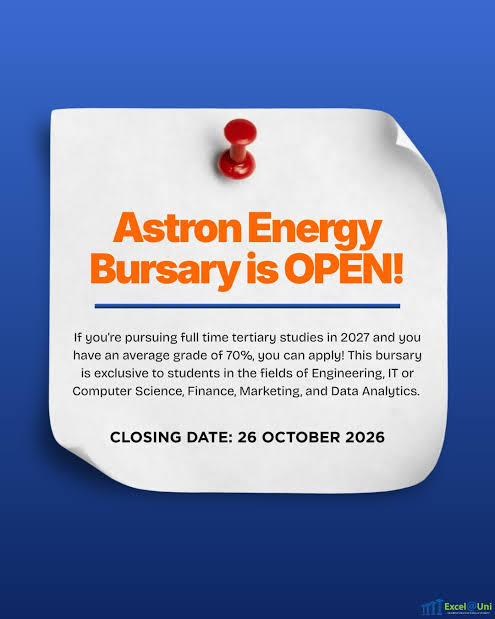
Applications close on 26 October 2026 at 12:00 midday. Today is 17 October, so you have about nine days. If you qualify, begin collecting your documents today, because certified copies take the longest.
Direct Application Link
Apply here: Astron Energy Bursary Application 2027
Applications are made online through this portal. The page that lists the bursary also asks you to answer a “how did you hear about us” question, so answer that field honestly with where you actually found the opportunity.
Table of Contents
- Introduction
- Bursary or scholarship?
- About Astron Energy
- Who runs the programme: Excel@Uni
- Fields of study covered
- What the bursary pays for
- Extra support for recipients
- Eligibility, explained one rule at a time
- Documents checklist and certification tips
- Step-by-step application process
- A nine-day plan to finish before the deadline
- How to write a strong motivational letter
- How to write your CV
- Selection timeline
- The work-back condition
- Common mistakes
- If you are unsuccessful
- Frequently asked questions
- Final thoughts
1. Introduction
Paying for university is the biggest reason talented students in South Africa drop out or never start. A full bursary removes that obstacle. Astron Energy is offering a full bursary for 2027 covering tuition, textbooks, accommodation, meals and monthly allowances. It is open to undergraduate and postgraduate students.
This guide covers everything you need to know before you apply: who qualifies, what is covered, which documents to prepare, how to write a strong application, and what to do if things don’t go your way.
2. Bursary or Scholarship?
People often search for “Astron Energy bursary and scholarship” as if they were the same thing. This programme is a bursary: funding for your studies in exchange for a commitment to work for the company after graduation (see section 15). Scholarships are usually awarded purely on merit and carry no work obligation, so read this programme’s terms with that difference in mind.
3. About Astron Energy
Astron Energy is one of the top two suppliers of petroleum products in South Africa, with a network of around 850 Caltex-branded service stations. It runs one of the country’s biggest crude oil refineries in Cape Town, producing petrol, diesel, jet fuel, LPG and other products, and operates a lubricants manufacturing plant in Durban. The company’s South African history dates back to 1911.
The company says it is committed to cutting its carbon footprint and keeping high environmental and safety standards. Its Cape Town refinery recycles water for its refining process, and its Cape Town headquarters holds a Green Star rating.
A company this size needs people in engineering, technology, finance, audit, marketing and risk, which is exactly the list of fields the bursary supports.
4. Who Runs the Programme: Excel@Uni
The Astron Energy bursary is administered by Excel@Uni. Administrators handle applications, screening and ongoing student support. This matters to you in practice:
- Questions about the application go to Excel@Uni, not to Astron Energy.
- The support chat button (blue, at the bottom of the application page) and the email [email protected] are the official contact routes.
- Your support services after you are accepted also come from them.
5. Fields of Study Covered
The 2027 bursary covers these fields:
Data Analytics. Working with large data sets to find patterns and guide business decisions. Relevant to fuel demand forecasting, supply chain planning and customer insight.
Engineering. Chemical, Electrical and Mechanical Engineering, at BSc or BEng level only. BTech is not accepted. This is the most common mistake engineering applicants make. If you study a BTech or National Diploma, this bursary is not for you.
Information Technology and Computer Science. Systems, software, networks and cybersecurity that keep a national fuel network running.
Finance. Accounting, general finance and commerce.
Financial Information Systems. The overlap of accounting and technology.
Internal Audit. Checking that processes, controls and reporting are sound.
Marketing. Brand, customer and retail strategy.
Risk Management. Identifying and managing financial, operational and safety risks.
The qualification can be at a registered South African institution, including private colleges and TVET colleges, as long as it falls under a listed field. Compare your exact qualification name with this list before you spend time on the application.
6. What the Bursary Pays For
The bursary provides full cover for tuition fees, textbooks, accommodation, meals and monthly allowances. The monthly allowance amount is confirmed during the application process. Look for it in the portal rather than relying on third-party websites.
In practical terms, “full cover” means you should not need to worry about registration, class materials, residence fees or daily food costs. For many students, that stability is what makes a distinction pass possible.
7. Extra Support for Recipients
Beyond the money, the programme includes support designed to keep you in your degree and prepare you for work:
- Psycho-social support. Continuous support provided by Excel@Uni. University can be isolating, especially for first-generation students, and this helps with stress and personal challenges.
- Light-touch mentorship. Mentorship for developing the skills that matter for personal and professional growth.
- Work Readiness Programme. Access to a programme that prepares you for the workplace. Expect help with things like professional communication and workplace expectations.
- Academic support. Private tutoring. If a module is giving you trouble, you don’t have to struggle alone.
8. Eligibility, Explained One Rule at a Time
You must meet every requirement. An application that fails any one of them will not be considered. Here is the full list with practical notes (the notes are my own advice).
1. You must be a South African citizen. Have your ID ready, because you will need a certified copy.
2. You must be under 35. Check your age on the application date.
3. You must have completed Matric. Your Matric results should be consistent with your records.
4. You must study, or intend to study, full-time. The qualification can be a diploma, advanced diploma, degree, honours or master’s, in a listed field. Part-time and distance programmes may not meet this requirement, so ask support if you’re unsure.
5. It must be your first time at this qualification level. You must not be repeating a degree. If you changed degrees or are repeating years, ask the administrator how your record is treated.
6. Your institution must be a registered South African higher education institution. Private colleges, community colleges and TVET colleges are included.
7. You need a 70% overall average for your last full academic year. This is a minimum. Use your official overall average from your transcript, not your best subjects. If your average is below 70%, applying will likely waste your time.
8. You must not be employed full-time. Full-time employment disqualifies you. Part-time or casual work is a different matter, but if you are in doubt, ask support before applying.
9. Documents Checklist and Certification Tips
The documents below are compulsory. If any are missing, your application may be disqualified. Certified documents must be less than three months old.
- ID document (certified copy)
- Full tertiary academic records for all years of study (certified copy)
- Latest academic transcript or official institution report (certified copy)
- Official university fee statements (include your lease agreement if you live off-campus)
- Proof of other bursary awards or NSFAS (bursary agreement, letter or offer), if applicable
- Parents’ or guardians’ ID documents, or death certificates if they have passed away (certified copies)
- A signed parental consent form, if you are under 18
- A doctor’s letter and the Department of Labour EEA1 form, if you have a disability
- A motivational letter (one to two pages)
- A comprehensive CV
Certification tips:
- Go early. Police stations and post offices often have long queues near deadlines.
- Take originals and photocopies, and have each copy stamped and signed.
- Make sure stamps are legible and dated within the last three months.
- Scan documents flat and clearly. A blurry upload can cost you.
- Save everything in one folder with clear file names, such as “Transcript-2025.pdf”.
10. Step-by-Step Application Process
- Check your eligibility against section 8.
- Collect and certify documents.
- Write your motivational letter and update your CV.
- Open the portal and create your profile.
- Complete every section of the application form accurately.
- Upload all documents, checking that each file opens properly.
- Review the whole application, then submit.
- Keep your confirmation (screenshot or email) as proof.
- Watch your email and phone until the end of January 2027.
11. A Nine-Day Plan to Finish Before the Deadline
This schedule is my suggestion for the days left:
- 17–18 October: Confirm eligibility. Download your transcripts and fee statement. Request anything you can’t get yourself, such as a guardian’s ID copy.
- 19–20 October: Get documents certified.
- 21–22 October: Draft your motivational letter and CV.
- 23 October: Ask someone to proofread both.
- 24 October: Create your portal profile, fill in the form and upload documents.
- 25 October: Final review. Fix any problems.
- 26 October (before 12:00): Only as a safety margin. Submit earlier if possible.
Because the deadline is at noon, not midnight, don’t plan on submitting in the afternoon.
12. How to Write a Strong Motivational Letter
The letter should be one to two pages. These are my own suggestions on structure and content; the bursary provider doesn’t publish a scoring guide.
Opening (two to three sentences). Say who you are, what you study and where. Add one detail that makes you memorable.
Paragraph two: your field and your reasons. Explain why you chose your degree. Name a specific moment, such as a school project, a teacher, a problem in your community or a power cut that made you curious about electrical systems.
Paragraph three: your achievements. Mention marks, projects, leadership roles, volunteering or competitions. Give evidence, not adjectives.
Paragraph four: your circumstances. Describe your financial situation honestly and respectfully. Be clear about how the funding will change what you can do.
Paragraph five: why Astron Energy and the energy sector. Show you know the company and its work. Connect your career goals to what the sector needs.
Closing. Thank the reader, confirm that you understand the work-back obligation, and state your commitment.
Template outline (fill in your own details):
My name is [name], and I am a [year] [degree] student at [institution]. [One memorable detail about you.]
I chose [field] because [specific reason]. [Short story or example.]
Academically, I have [average, awards, projects]. Beyond class, I [leadership, volunteering, work].
[Honest description of your situation and what funding would change.]
I am interested in Astron Energy because [specific reason]. After graduation, I hope to [goal].
I understand that the bursary includes a work-back commitment, and I welcome the opportunity. Thank you for considering my application.
Do: use your own voice, be specific, keep it honest, and proofread twice.
Don’t: copy templates word for word, exaggerate, or use the same letter for every bursary.
13. How to Write Your CV
The bursary asks for a comprehensive CV of your work experience and background. A good student CV is clear and easy to scan:
- Contact details: name, phone, email, city.
- Education: institution, qualification, year of study, average.
- Achievements: awards, dean’s list, competitions.
- Experience: part-time jobs, internships, volunteering, with what you did and what resulted.
- Skills: technical (Excel, Python, AutoCAD, SQL, as relevant), plus languages.
- References: two people, such as a lecturer and a supervisor, with their permission.
Keep it to two pages and use a clean, simple layout.
14. Selection Timeline
- Applications close: 26 October 2026 at 12:00 midday.
- Shortlisted candidates contacted: by 31 January 2027. If you receive no feedback by then, consider your application unsuccessful.
- After selection: successful applicants sign an agreement provided by the sponsor.
The wait is long, so keep applying for other funding in the meantime and don’t depend on one outcome.
15. The Work-Back Condition
After graduation, bursary holders must work for the company for every year of funding they received. If you receive three years of funding, you would work three years.
Think about whether you are comfortable with this. The advantages are real: a guaranteed first job and early career experience at a major company. The trade-off is less freedom in your first years after graduation. Read the agreement carefully, ask questions before signing, and keep a copy.
16. Common Mistakes to Avoid
- Applying with a qualification that isn’t on the list, or a BTech in engineering
- Submitting uncertified, expired or unclear copies
- Forgetting the fee statement or the lease agreement for off-campus students
- Leaving out parent or guardian documents
- Reporting an average you can’t prove
- Writing a generic letter
- Leaving the submission to the last hour
- Contacting Astron Energy instead of Excel@Uni
17. If You Are Unsuccessful
Thousands of students apply for bursaries, and many strong candidates miss out. If this happens:
- Apply for other bursaries. Other companies and funds run programmes in engineering, finance and IT, and many have deadlines in the coming months.
- Check NSFAS if your household income qualifies.
- Ask your university’s financial aid office about internal bursaries and payment arrangements.
- Keep your documents. Certified copies can be reused (while under three months old) and your motivational letter can be adapted for other applications.
- Strengthen your profile by improving your average, volunteering or building a relevant skill, then try again next year.
18. Frequently Asked Questions
When does the Astron Energy Bursary 2027 close?
26 October 2026 at 12:00 midday. Late applications are not accepted.
Where do I apply?
Use the link at the top of this article.
Is there an application fee?
No fee is mentioned in the listing I reviewed. Be wary of anyone who asks you to pay for a bursary application.
Can I apply if I study at a TVET or private college?
Yes, as long as the institution is registered and your qualification is in a listed field.
Can postgraduate students apply?
Yes. Honours and master’s qualifications in the listed fields are included.
Does the bursary cover accommodation?
Yes, along with tuition, textbooks, meals and monthly allowances.
What if my average is 68%?
The minimum is 70%, so you would not meet the requirement. Look at other bursaries with lower thresholds.
Do I have to be a first-time student?
Not exactly. You must be studying towards your qualification level for the first time, so you must not be repeating a degree.
Who do I contact with questions?
Excel@Uni, through the blue support chat on the application page or at
What if I hear nothing after the closing date?
If you receive no feedback by 31 January 2027, treat your application as unsuccessful.
19. Final Thoughts
The Astron Energy Bursary 2027 offers full funding, mentorship, tutoring and a clear route into a career in the energy sector. It also asks a lot: a strong academic average, a complete document set and a work commitment after graduation.
If you qualify, don’t wait. Certify your documents, write a letter that sounds like you, submit well before noon on 26 October 2026, and keep your proof of submission.
Note: the details in this article come from bursary listings, the most recent updated in October 2026. I could not confirm them on Astron Energy’s own website, so check the application portal for any changes before you submit.
I can also put this article in a document file if you’d like to publish or share it.



Conversation
0 Comments