
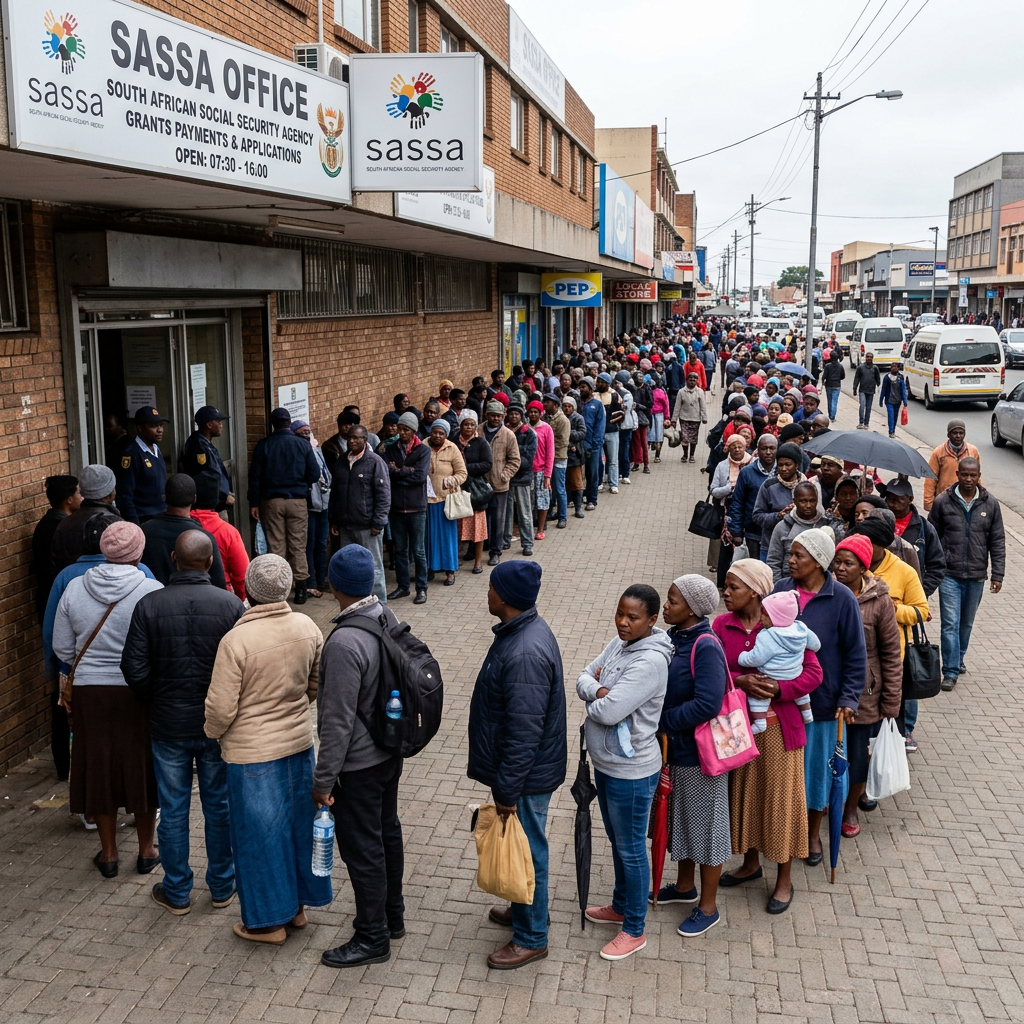
If you’re a SASSA beneficiary, or a learner from a household that receives a grant, and you plan to study in 2027, your next few weeks matter. You need to apply to a university or college, apply for NSFAS funding, and often get SASSA paperwork sorted. This guide covers how to do all of that without losing days standing in a queue.
Step 1: Check whether you need a SASSA office at all
Many people queue for things they could do online or by phone. Before you travel:
- Call the SASSA toll-free line: 0800 60 10 11
- Check your SRD status online: https://srd.sassa.gov.za
- Confirm your nearest office and its hours at https://www.sassa.gov.za
You usually only need a branch for ID problems, bank or payment-method changes, reinstating a cancelled grant, or getting a letter or proof that confirms your grant status.
Step 2: Pick your time
Best days: Local guides consistently recommend mid-week mornings, Tuesday to Thursday, with 07:30 to 09:00 given as the best window in Durban. In Gqeberha, arriving before 9:00 is advised.
Days to avoid: Grant payment periods, meaning the first and last week of the month, generate the longest queues. Mondays and Fridays are also usually busy. Check the official payment dates for your grant before you plan a trip.
Opening hours differ. Reported hours vary between sources, so confirm your specific office by phone. Satellite offices may operate on limited days.
One honest caution: one SASSA planning guide notes that queues depend on province, staffing, weather, transport strikes and the service you need. The safest rule is to go as early as you can, once you’re sure a visit is needed and you have the right documents.
Documents to bring
- Your ID (or smart card) and a certified copy
- Proof of address
- Bank letter or stamped bank statement, if you’re changing payment details
- Any SASSA reference or application number
- Your matric results or latest school report (you’ll need these for your university application anyway)
Put everything in one folder. Missing one document is the most common reason people have to come back.
Step 3: Apply to universities and colleges for 2027
Applying to the institution and applying for funding are separate processes. Do both.
Most South African universities open applications between March and August of the year before, and closing dates vary by institution and course, so check each one’s page now. If you’re still undecided, apply to more than one institution and more than one course.
Direct application links (official sites):
| Where | Link |
|---|---|
| Central Applications Office (KZN institutions) | https://www.cao.ac.za |
| University of the Witwatersrand | https://www.wits.ac.za |
| University of Pretoria | https://www.up.ac.za |
| University of Johannesburg | https://www.uj.ac.za |
| University of Cape Town | https://www.uct.ac.za |
| Stellenbosch University | https://www.sun.ac.za |
| UNISA | https://www.unisa.ac.za |
Each site has an “Apply” or “Admissions” section. I’ve given the main addresses rather than deep links, because deep links change often. Only apply through the official university website, and never pay anyone who offers to “secure your place”.
TVET colleges: Public TVET college applications for 2027 were open until 30 September 2026. If you missed that, contact your nearest college directly, as some accept late applications for certain programmes. sanews
Step 4: Apply for NSFAS funding
Apply here: https://www.nsfas.org.za (applications are submitted through the myNSFAS portal, or the NSFAS mobile app on Android and iOS).
- Applications opened on 18 September 2026.
- NSFAS’s latest statement says the period closes on 31 October 2026, with no extension.
Some websites list 18 November 2026 as the closing date. Because the sources conflict, treat 31 October as your deadline and check nsfas.org.za to confirm. Early applications also give you time to fix problems.
Tips:
- Upload all required documents and make sure you actually submit, because an upload that isn’t sent isn’t received.
- Apply with your own details and email address, not someone else’s.
- Eligibility doesn’t guarantee a place to study, so you still need an admission offer from an institution. sanews
- NSFAS also faces funding pressure, so applying early and completely matters.
- Funding outcomes are expected in December, before registration.
Everything to know before you apply
- Check the admission requirements for your course: APS score, subject combinations and any minimum marks (maths, science, English).
- Know the dates for applications, NSFAS, registration and accommodation, and put them in your phone calendar.
- Have digital copies of your ID, results, proof of income and a parent or guardian’s ID ready as clear PDFs or photos.
- Make a safe email account and keep the password somewhere safe. All offers and NSFAS messages go there.
- Apply for accommodation separately. Residence applications often have their own deadlines.
- Think about backups. Apply for a second course, or a TVET or distance option, in case your first choice is full.
- Budget for hidden costs: application fees at some institutions, transport, data and books. NSFAS covers many of these for eligible students, but not always from day one.
- Learn about the missing-middle loan scheme if your household earns too much for NSFAS but can’t afford fees. The government says it is strengthening this option. sanews
- Watch out for scams. Official applications are free on NSFAS and the university portals, and officials never ask for your password or an upfront “processing fee”.
A simple two-week plan
- Day 1–2: Confirm you actually need a SASSA visit (call 0800 60 10 11).
- Day 3: Gather and scan all documents.
- Day 4–5: Submit your NSFAS application.
- Day 6–10: Submit university or college applications.
- Day 11: If you need an office visit, go on a Tuesday to Thursday morning.
- Day 12–14: Track your applications and check your emails and SMSs.
Final word
Queues are easier to beat with a plan: go mid-week and early, stay away from payment weeks, and arrive with every document. Your 2027 funding deadline is the part you can’t afford to miss.
Check all dates and requirements on the official websites before you act, as they can change.
I can also turn this into a Word document or a shorter blog-style version if you’d like.


Conversation
0 Comments